Is my own hand rub still safe to use?
One of the topics covered in Option D: Medicinal chemistry is antibiotic resistance. This occurs when micro-organisms become resistant to antibacterials. There is considerable concern in many parts of the world about patients in hospitals developing ‘superbug’ infections as some bacteria, e.g. Staphylococcus aureus (MRSA) and Enterococcus faecium, have become very resistant to antibiotics commonly used today. Most hospitals now have a strict procedure for santitising the hands and these involve hand-rub solutions which are alcohol based. A nice example of how quickly bacteria can develop resistance is detailed in a recent study entitled “Increasing tolerance of hospital Enterococcus faecium to handwash alcohols”. Australian scientists working at the University of Melbourne have shown that until 2010 hand rub solutions containing isopropanol (propan-2-ol) were very effective against samples containing Enterococcus faecium. Since then however they have shown that E. faecium bacteria have developed resistance to isopropanol and hospital infections due to E. faecium are increasing. The research paper has ‘alcohols’ in its title but upon careful reading it seems as if only hand washes containing isopropanol were tested.
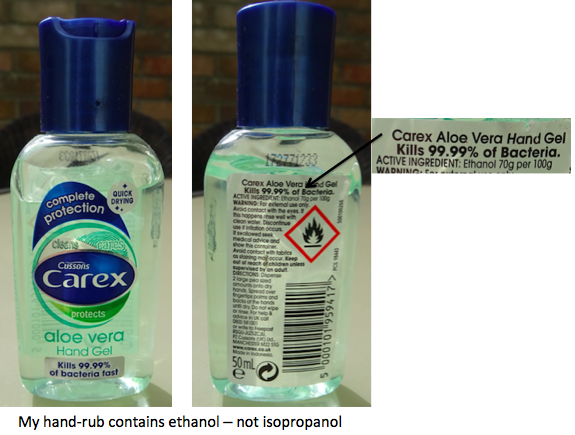
I have a hand rub that I sometimes use when I’m travelling but it contains ethanol not isopropanol. In common language alcohol normally means ethanol but reading this research paper it is not clear to me whether it has been shown conclusively that E. faecium has developed resistance to all alcohols (as the title of the research paper implies) or only the one most commonly used in hospitals, isopropanol. Is my own hand rub still safe to use?