Essay frameworks for P1 & P2
Essay frameworks for Paper 1 and Paper 2

These are suggested writing frameworks to use for the extended response (essay) questions in Paper 1 and Paper 2 (both worth 10 marks). Examples of 10-mark questions are shown below to provide some context.
| 1. | Using a SWOT analysis, discuss whether Company A should merge with Company B. | [10 marks] |
| 2. | Justify YY's decision to reshore Company X's operations to Vietnam. | [10 marks] |
| 3. | Using your calculations from Question XX and the information in the stimulus, discuss whether Company B should choose Option 1 or Option 2. |
|
| 4. | Discuss whether Company X should expand into the YY market. | [10 marks] |
| 5. | Recommend whether Company A should accept the offer from Company B to merge. | [10 marks] |
| 6. | To what extent is social media marketing (SMM) an effective promotional strategy for Company X? |
|
| 7. | Using the financial information in Table 1, evaluate two strategies that Company X could use to improve its financial position other than changing to a just-in-time (JIT) stock control method. (HL only) |
|
| 8. | Examine the impacts of ethical implications of advanced computer technologies for Company X. (HL only) |
|
| 9. | Using the data in Table 1, other information in the stimulus, and Porter's generic strategies, recommend which marketing strategy Company Y should use to gain a competitor advantage over its competitors. (HL only) |
|
| 10. | Using Table 2 and the stimulus material, discuss two possible approaches to conflict resolution that YY could use at Company X. (HL only) |
|
It is important to note that none of these frameworks is prescribed by the IB. They are simply teaching strategies designed to help students structure their responses and demonstrate the assessment objectives effectively. Students should use whichever approaches help them construct clear, relevant, analytical, and evaluative answers.
1. The DEAD and DEADER framework
Many years ago, two colleagues (Brett Hillman and Fiona Charnley) from the Queensland Academies SMT in Australia shared a top tip during an IB Workshop that I was running in Hong Kong: the DEAD and DEADER framework.
In order to gain a Level 6 (for AO2 questions worth up to 6 marks), students have to demonstrate the following:
• Define
• Explain / give examples
• Advantages
• Disadvantages
Then, in order to gain a Level 7 (for AO3 questions worth 10 marks) students need to demonstrate two more skills:
• Define
• Explain / give examples
• Advantages
• Disadvantages
• Evaluate
• Recommendations*

* Note that R could be used for Reflection if the command term is not “Recommend” but any other AO3 command term, such as “Discuss” or “Evaluate”.
I particularly like the DEADER acronym as the ‘Recommendations’ reminds us that IB Business and Management is ultimately about problem-solving and decision-making in business organizations.
Although this framework has been used for more than 15 years now, it continues to help many students to construct their arguments in an analytical and evaluative way.
Click the icon below to read more about how to answer "Examine", "Evaluate" and "Discuss" questions using the DEAD and DEADER framework.
How to use the DEAD and DEADER framework
Part 1 - "Explain", "Analyse" or any other AO2 command terms for questions worth up to 6 marks.
If you are asked to explain something (as a command term in the exams), you will need to provide a detailed account of it, including reasons or causes where appropriate. For example, students could be asked to explain the choice of a particular pricing method for a given business or its choice of production method (operation method). Wherever possible, try to use examples from the stimulus material to improve the application and the quality of your explanations. A useful acronym to remember is DEAD.
Location in your answer | DEAD framework | Example: Explain two options for Company X’s overseas expansion plans. |
| At the beginning | Definitions of relevant terms | Definition of expansion (growth) and other relevant key terms |
| Throughout the answer | Examples from the case study (stimulus material). | Apply examples from the case study, using the stimulus information / data provided |
| Main body | Advantages | Explain the advantages* of each option or decision |
| Main body | Disadvantages | Explain the disadvantages* of each option or decision |
* Advantages and Disadvantages as part of the DEAD framework are simply an easy way to remember that you need to include both sides of an argument in your answer. For example, for the question "Analyse the view that employees at Company X are motivated by non-financial rewards." for 6 marks would require students to explain or consider the advantages versus disadvantages of Company X using non-financial rewards to (re)motivate its workers. This could entail consideration of the merits of financial versus rather than non-financial motivators, for example. In any case, answers that score the highest marks must demonstrate a balance in the consideration of both sides of an argument or issue.
Part 2 - "Discuss", "Recommend" and "Evaluate" questions for 10 marks.
With these more challenging AO3 command words, you are being asked to make an assessment and judgement about a particular business problem, issue, or decision. You must use the information available in the case study (stimulus material) as well as your own knowledge of business management in order to answer the question in a considered and reflective way.
All AO3 command terms require you to show evidence of critical and reflective thinking (such as "Evaluate the view that employees at Company X are only motivated by financial rewards"). This means that you must make suggestions as to why / why not something would / would not, in your opinion, be appropriate or relevant to the issue being discussed. In this case, it is prudent to offer support (evidence) to your arguments/opinions using evidence from the stimulus material as well as appropriate application of Business Management tools, theories, and techniques.
The answer should end with a decisive conclusion that answers the question in its entirety, such as “On balance, given the above considerations, ....” - this kind of phrasing helps to frame your overall judgement and/or recommendation. A useful acronym to remember for these AO3 questions is DEADER.
Location in your answer | DEADER | Example: Applying suitable tools such as Ansoff’s growth matrix, and using information contained in the case study, evaluate the two expansion alternatives (Option 1 and 2) proposed by X. |
| In the introduction | Definitions of relevant key term(s) | Definition of Ansoff's matrix and expansion |
| Throughout the answer | Examples from the case study | Select and use relevant examples from the stimulus material in the case study |
| Main body | Advantages | Advantages of each growth option |
| Main body | Disadvantages | Disadvantages of each growth option |
| Main body and in the conclusion | Evaluation** | This is where you show your judgements and opinions of each growth option. These must be substantiated, using evidence from the case study. |
| Conclusion | Recommendation** (or Reflections) | Your justified recommendation to X regarding which growth option to pursue. |
**In order to reach the higher mark bands for "Evaluate", "Discuss" or any other AO3 questions, you must include a substantiated judgement (i.e., your conclusion synthesizes which course of action the organization should pursue as well as the justified reasons why this course of action is the best decision available to the business given the circumstances and contexts outlined in the case study.
Note: Answers that do not include a balanced and evaluative judgement (that is substantiated by logic, evidence, and reasoning) cannot reach the upper end of the available mark band for the 10-mark question. This includes an explanation of the limitations of the information provided in the stimulus material.
2. The SSCCOOMM framework
Barbara Cooper, former Head of Business and Vocational Education at West Island School (English Schools Foundation) in Hong Kong, and Vice Principal at Creative Secondary School in Hong Kong, introduced me to the SSCCOOMM framework when considering conclusions and business strategy in an extended response question:
• Stakeholder influence
• Short term / long term
• Cost implications
• Change management
• Opportunity cost
• Objectives
• Market trends
• Management and leadership styles / expertise / preference.
Aspects of the SSCCOOMM framework can also be useful for the extended response question in Paper 3 for HL only (worth 17 marks).
There is no expectation that students cover all aspects of SSCCOOMM; it is just a framework to help students organize their thinking and their structure when constructing conclusions in their essays.
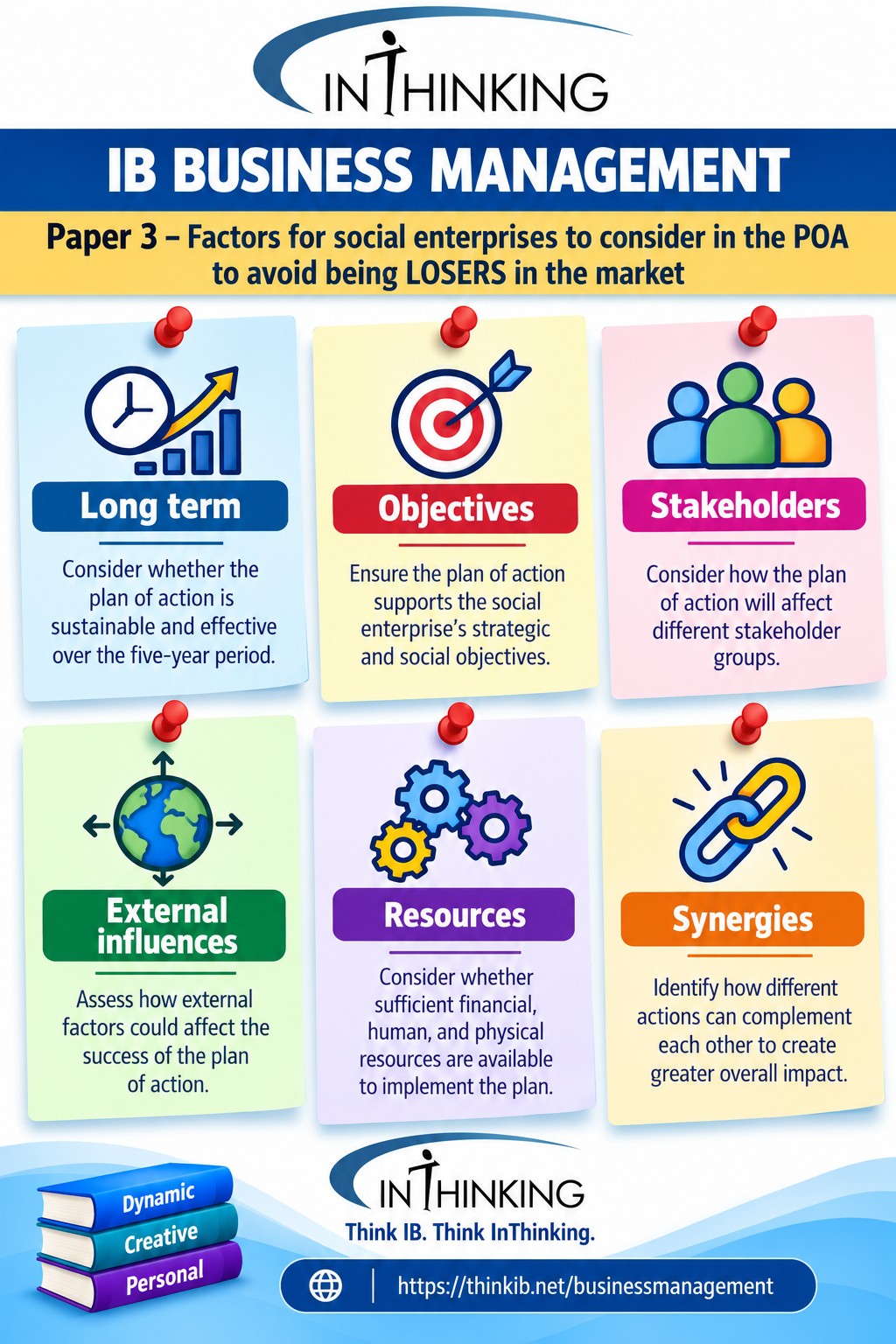
3. The LOSERS© framework

My personal favourite acronym is the LOSERS framework. In evaluating the strategic options and decisions of businesses, it is important for managers and key decision makers to consider the following; otherwise they will simply be LOSERS:
• Long term – strategic decision-making is about a firm’s future direction and competitiveness.
• Objectives – are the strategic decisions in line with the organization’s corporate objectives?
• Stakeholders – who are the key stakeholders? Which ones are most affected by the decision?
• External environment – what are the constraining and driving forces that are beyond the firm’s control?
• Resources – does the business have the financial and human resources to implement the plans?
• Synergies – overall, does the strategy add value (synergy) to the organization?
Again, aspects of the LOSERS framework can be useful for the extended response question in Paper 3.
Teachers can download the LOSERS poster for Paper 3 below to use with their students.
To save or print this poster, hover your mouse over the image and right click to select the preferred option (save, print, or save/download).
4. The CLASPS framework

A useful acronym that you can use for demonstrating skills of evaluation and reflection in the exams is CLASPS. A clasp is something that holds things together - like a peg or keyring, so is apt in helping you to evaluate the discussion points in the extended response questions. Note: there is no need to include all six of these components to demonstrate critical and reflective thinking in your answers to the extended response questions in Paper 1 and 2.
CLASPS stands for:
- Conclusion – this should include a synthesis of the arguments presented in your work, with a decision / answer that addresses the demands of the question. Useful phrases for synthesis include "To sum up, ...", "All things considered, ...", and "Taking everything into consideration, ..."
- Long term vs. short term implications of the points discussed and/or the recommendations made.
- Assumptions – what does the case study / stimulus material not reveal that might be critical to the question being discussed?
- Stakeholder perspectives, including the views of individual and group stakeholders.
- Priorities – which of the arguments presented in the extended response question and answer is of most significance / importance / relevance to the organization, and why?
- Strengths and shortcomings – consider both the advantages and disadvantages of your conclusion and/or recommendations made.
5. The DARE framework

When structuring extended response questions, students might also find it useful to use the DARE framework, where they show evidence of the following:
- Definitions or descriptions (of business management terms or theories that are directly relevant to the question).
- Application (always write in the context of the case study); just mentioning the name of the organization is not considered as application.
- Reasoning (always substantiate your arguments, and do not allow examiners to ever question "why?")
- Evaluation (to reach the top mark band, students must show evidence of reflective and critical thinking, i.e., a well justified evaluation or judgement).
6. The PEELS framework
Students can use the PEELS framework for writing their extended response answers in both Paper 1 and Paper 2 in the IB Business Management exams. This will help to ensure their paragraphs in are fit for purpose.
/peels.jpg)
Top tip 1!
Writing fit for purpose paragraphs also requires explanations or analyses that include the effects (impacts) or significance of the issues discussed. For top marks, you must include relevant Business Management terms, tools, theories, and/or techniques in a concise manner, and in the context of the case study.
7. The LOST SMS framework
This top tip comes from our esteemed IBEN colleague Dr. Rima Puri who uses the LOST SMS framework with her students to develop skills of evaluation:
- Long run - impacts of the decision in the long run
- Objectives - the purpose of the decision and its relevance to the business organization
- Short run - impacts of the decision in the short run
- Time bound - what is more important in the short run and whether/how this differs in the long run
- Stakeholders - impacts of the decision on key stakeholder (individuals and group stakeholders)
- Measurable - financial and other quantitative implications of the decision
- Specific - application of specific information/data from the stimulus material.

Top tip 2!
When writing extended response questions in the Paper 1 and/or Paper 2 examination, any of the above frameworks can be used. Also, for questions about an organization's strategy or plan of action (such as “Discuss the options for ...”), it can be useful to write your answers using this three-stage framework:
1. Strategic analysis – where is the organization now?
2. Strategic choice – where does the organization want to be?
3. Strategic implementation – how does the organization get there?
This framework can also help some students with the 17-mark extended response question in Paper 3 that requires students to recommend a suitable plan of action (strategy) to maintain its operations or improve its competitiveness.
ATL Activity (Thinking skills) - Writing effective conclusions

Always write conclusions to end your extended responses
Ask students to have a go at completing these sentence starters below for the conclusion of any 10 mark question in Paper 1 and/or Paper 2.
These starter sentences should lead students to write complex analytical and evaluative phrases to demonstrate critical and reflective thinking. Completed well, the responses should gain credit for the AO3 mark band of the assessment criteria. Try to use relevant key terms from the topic in question, as well as specific details from the given case study.
- The discussions have led me to conclude that …
- In conclusion, the outcome / decision depends on ... because …
- Although arriving at the conclusion stated above, the evidence could be questioned because …
- The case study suggests there are more (less) benefits than costs, which is important because …
- Although the evidence leads me to conclude that ... other important factors that should be considered include …
- By comparing the options, it can be seen that …
- From this information provided in the case study, it can be concluded that ... outweighs … because ...
- Different stakeholders have different perceptions of the value of ... because …
- The final decision will be affected by …
- The impact is likely to have more (less) negative than positive long-term impacts because …
Every student response will be somewhat different but try to encourage well-considered / in-depth arguments and fit-for-purpose paragraphs. Encourage the inclusion of appropriate key terms and specific application of the information contained in the given case study.
To reach the 9-10 mark band in the new Paper 1 and Paper 2 exams, students must show evidence of the following:
- Clear focus on addressing the demands of the question.
- Relevant and accurate use of business management tools and theories.
- Relevant information from the stimulus material is integrated effectively to support the argument.
- Arguments are substantiated and balanced, with an explanation of the limitations of the case study or stimulus material.
The fourth and final point above is a prompt for demonstrating evaluation skills. It is about acknowledging that there are limitations in the stimulus that, if addressed, would improve the objectivity and quality of the conclusion, recommendation, or overall judgement.
Top tip 3!
Avoid overwhelming students with too many acronyms. It is far better for them to become confident in using a small number of effective frameworks than to memorise numerous techniques without understanding their purpose.
Ultimately, examiners reward the quality of students' responses against the published assessment criteria, not their ability to follow a particular writing formula. The frameworks above are there to support good examination technique, not replace independent and critical thinking.
Whichever framework or style is used, remember that clarity is vital in all written responses.
As Albert Einstein said, "If you can't explain it simply (so that others can understand you), you don't understand it well enough."
Watch this very short but self-explanatory video clip for clarification of this recommendation (humour intended, but offence unintended).
Return to the Exams homepage
