Role of HRM
Role of human resource management (AO2)
.jpg)
Human resource management (HRM) is a broad term used to describe the overall management of an organization's workforce. This includes roles such as attracting, selecting, training, assessing, motivating, rewarding, and retaining employees. Essentially, the role of HRM is to make the most efficient use of an organization’s workers. Due to the evolving workforce planning needs of an organization, human resource management is an ongoing function of the personnel department of an organization.
Effective human resource management is vital for any organization to achieve its business objectives. The role of human resource management is therefore important as the effectiveness of the workforce has a major impact on the current and future success of the organization. HR managers play a vital role in ensuring that the right people in the right numbers are hired, at the right time, deployed in the right places, and at the right time.

HRM plays a vital role in the smooth running of any business
Human resource management involves numerous roles or functions, which include:
- Recruitment - hiring the right number of appropriately qualified and suitable workers at the right times to fill job vacancies.
- Induction - training for new employees to get acclimatised with the norms and operations of the organization.
- Retention - retaining/keeping workers at the organization by meeting the needs of employees.
- Appraisals - the formal procedure of assessing the performance and effectiveness of employees in relation to their job description as well as holding workers accountable for their performance/conduct at work.
- Absenteeism - dealing with issues that arise when employees are unable to attend work (see Case Study 1).
- Dismissal - letting go of workers no longer needed, often due to underperformance or misconduct in the workplace.
- Redundancies - letting go of workers if/when their jobs are no longer needed, perhaps due to a prolonged economic recession.
- Training and development - improving the competencies, productivity, and skills of workers.
Ultimately, effective human resource planning enables an organization to develop competitive advantages, as the workforce is more effective in achieving the firm’s aims and objectives.
Case Study 1 - The absenteeism costs of the common flu in the USA
- The USA spends $10.4bn per year in direct medical expenses - that's around $28 493 150 per day!
- The country loses $15.3bn a year from the common flu due to loss of earnings (which is equivalent to 17 million workdays a year!)
- Productivity losses amount to more than $21 billion a year (or over $57.53 million per day).
Source: adapted from www.healthline.com/health
ATL Activity 1 - To work or not to work, that is the question
On average, women have a higher life expectancy compared to men. This may be due to inherent biological factors. However, women also retire earlier in many countries as compared to men. The gap between the retirement age of men and women is smaller in high-income countries and larger in low-income and medium-income countries due to economic and social factors.
So, if men live shorter lives and are expected to work more (retire at a later stage in life), is this fair? What about equality for males? Are governments biased?
Refer to these three sources and discuss the above questions in small groups.
Key concept - Ethics
“Ethics is a code of values which guide our choices and actions, and determine the purpose and course of our lives”.
- Ayn Rand (1905 – 1982), Russian-American writer and philosopher

Ethics can be defined as the moral codes of conduct that drive business behaviour. Ethical business behaviour is what is deemed by society to be morally acceptable, i.e., what is “right”. By contrast, unethical business behaviour is what society regards as being immoral, unjust and unfair, i.e., what is “wrong”.
Ethics can affect all aspects of human resource management and decision-making. For example, unethical practices of some offshored businesses, such as the immoral exploitation of workers, have led more organizations to re-shore their operations. Other ethical considerations include:
- Should employers allow workers to have tattoos? Is it appropriate (acceptable) for teachers in international schools to have visible tattoos? Should there be a law about exposing tattoos in the workplace?
- Should employment laws be enforced across the globe to prevent discrimination against race, gender, marital status, age, religion and sexual orientation? Why/not?
- Is it ethical for senior executives to receive end-of-year bonuses that are more than double their employee’s annual salary?
- Is it morally acceptable for firms to hire more part-time and flexitime workers in order to lower their production costs?
Unethical business behaviour can have major consequences for a business, such as poorer staff morale, lower productivity, an undesirable corporate image, and possible lawsuits against the organization. For example, Walmart has been accused of mistreating its workers, especially the exploitation of female workers on part time contracts.
Case Study 2 - Accusations of employee exploitation at iPhone factory

One of the key issues associated with offshoring is the potential for disputes between suppliers and workers, particularly in regions where labour regulations and enforcement mechanisms may differ from those in the home country of the multinational company.
In December 2020, reports emerged of workplace unrest at an iPhone factory operated by Wistron Infocomm Manufacturing near Bangalore, a major IT centre in India. Workers protested over concerns related to wages and working hours. According to media reports, some employees claimed they had experienced delays in payment and were required to work additional shifts. The protests resulted in damage to factory property.
Company representatives stated that they were committed to complying with local labour laws and relevant regulations. The factory employs approximately 15 000 workers.
In such circumstances, labour disputes can occur rapidly as governments, employers, and employees adjust to changing economic and cultural conditions. Such situations highlight the importance of effective human resource management, clear communications, and compliance with labour standards in global supply chains.
Source: adapted from South China Morning Post
Human resource managers are increasingly relying on innovative technologies as part of their work. For example, developments in online and mobile banking have cut the need for banking staff. The huge popularity of social media networks (such as LinkedIn, Instagram, Facebook, and Twitter) has created opportunities for organizations to attract workers. LinkedIn, for example, is being increasingly used by businesses to headhunt employees.
Watch this Wall Street Journal video clip about the innovative culture at Google. The company prides itself on being innovative, so hiring employees who are free to be highly creative individuals is vital.
Key concept - Creativity
In business management, a creative workforce and culture of creativity can give a business competitive edges. Consider some of the examples below:
- Airbnb has become the world’s largest property rentals company, but it does not own any properties.
- Alibaba.com is the world’s largest B2B (business to business) online platform, but does not have any inventories.
- Amazon.com transformed the (online) retail industry, putting lots of traditional retailers out of business in the process.
- Cloud computing, such as Google Drive and Dropbox, has reduced the demand for computers and laptops with large physical storage devices.
- Google Maps and mobile technologies have wiped out the demand for satellite navigation devices.
- iTunes and Spotify have revolutionised the music industry.
- Netflix is the world's largest provider of movies but doesn't own any cinemas of its own.
- Skype, Teams, and Zoom have changed the way in which many multinational companies conduct their meetings and interviews (via video conferencing technologies), yet these companies do not own any telecommunications infrastructure.
- Tesla’s creative and innovatively designed products have sparked huge interest in all-electric vehicles.
- Uber, the world’s largest taxi operator, does not own any taxis.
How do the above cases impact on the role of human resource management?
Business Management Toolkit (BMT) - Descriptive statistics
In order to support the HR department, organizations use a range of supporting quantitative information and statistical data, including:
- Annual labour turnover figures
- Absenteeism records
- Business objectives
- Demographic trends from government sources
- Labour productivity data
- Labour turnover rates
- Management knowledge and experience
- Growth rates of the organization (see chart below for Amazon from Statista)
- Sales forecasts
- The state of the economy, such as GDP, unemployment and inflation figures.
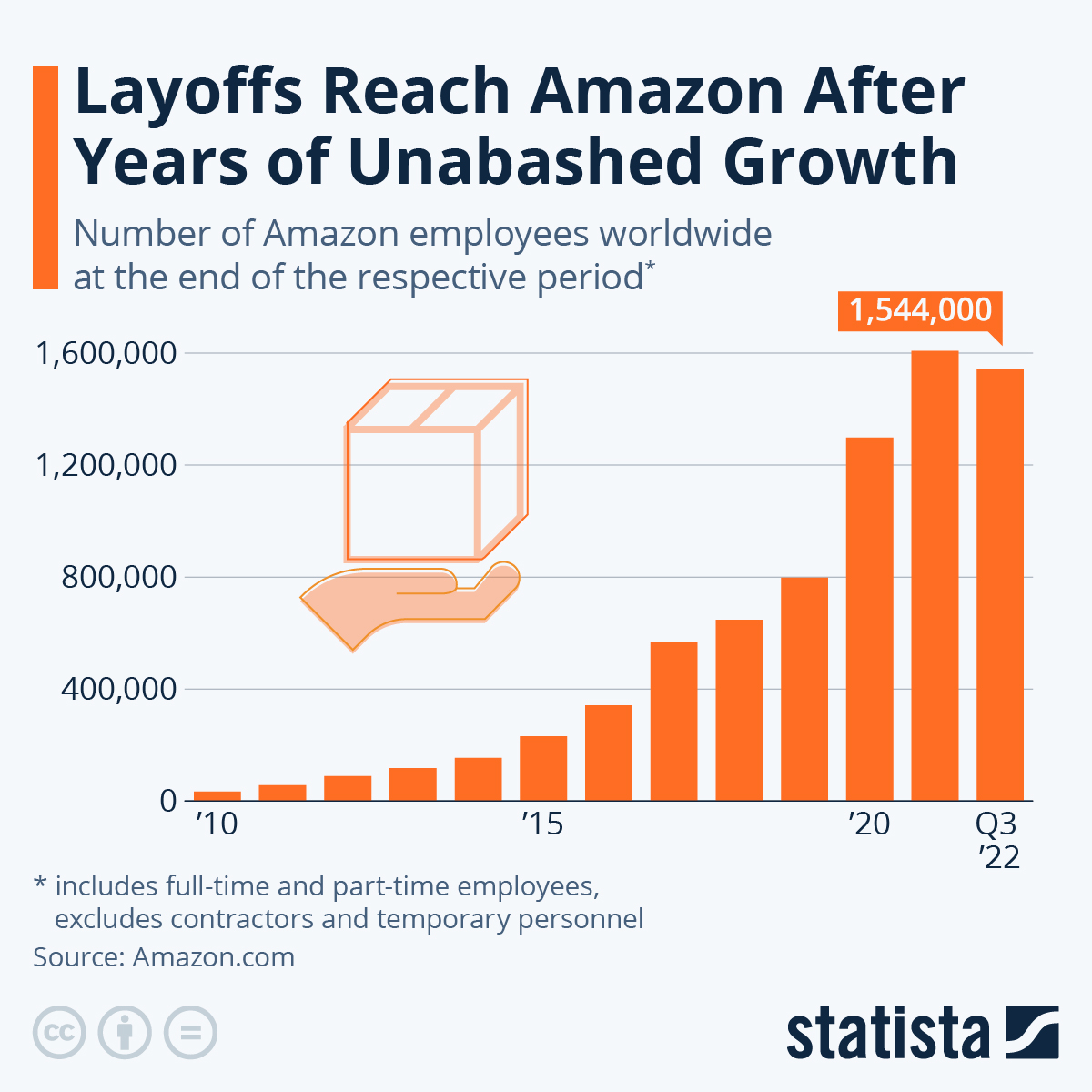
Discuss the use of descriptive statistics in supporting the role of human resource management.
Business Management Toolkit (BMT) - Hofstede's cultural dimensions (HL only)

Culture is often described as "the way things are done here". Corporate culture refers to a set of beliefs and work attitude that is accepted in an organization. It can refer to the norms within an organization (such as the dress code within a business) and national or regional cultures (and how these impact on the organizational culture).
In terms of business management, culture refers to the norms, attitudes, values, goals, and practices that characterises an organization. It can apply to an organization, a country or a region of the world. Organizations will want to develop a strong and cohesive culture, where labour turnover is low and productivity is high, due to effective human resource management.
Attitudes and approaches to:
- Appraisals
- Dismissals and redundancies
- Hiring migrant workers
- Outsourcing, offshoring and re-shoring
- Training and professional development
Individuals can shape organizational culture, just as organizations can shape individuals. Procedures and processes for managing human resources are explicitly shaped by traditions and cultures. National and regional cultural differences still exist within any organization, despite the forces of globalization bringing the world closer together. Hence, to manage human resources successfully, businesses have to adapt to cultural diversity within their organizations.
ATL Activity 2 - Looking after your parents

Read this interesting article from The Economist, titled ‘Which countries are most generous to new parents?’ Click the link here.
Contrast how these practices differ from a country that you are familiar with.
Theory of Knowledge (TOK)
Should a business deliberately/intentionally hire a culturally diverse workforce? Why or why not?
ATL Activity 3 - Video documentary review
Watch this 43-minutes Undercover Boss video documentary about Buffalo Wings & Rings in the USA. The video follows the CEO, Nader Masadeh, as he goes undercover to find out about the staff behind the Buffalo Wings & Rings franchise, with hopes of further expansion. Along the way, Nader Masadeh finds good employees but also a bully who needs to be dealt with.
You can access the video on Daily Motion here.
Use this video as a real-world example of human resource management in action. The video covers many aspects of the Unit 2 syllabus, including human resource planning, organizational structure, leadership and management, motivation, and organizational culture.
Questions
Q1 - Where is Buffalo Wings & Rings headquartered and how many employees does the company have?
Q2 - Who is the President of Buffalo Wings & Rings, and how much does he earn a year?
Q3 - Where was the CEO of Buffalo Wings & Rings born?
Q4 - When did the first Buffalo Wings & Rings restaurant open?
Q5 - When did Masadeh buy the Buffalo Wings & Rings franchise, and how many stores did they have then?
Q6 - How many pounds (lbs) of chicken does Buffalo Wings & Rings use each year?
Q7 - What did Nader Masadeh purchase to celebrate the birth of the business in 1984?
Q8 - What is the reason behind Nader Masadeh going undercover?
Q9 - What was Nadeer Masadeh’s undercover name?
Q10 - Where is the first restaurant that Masadeh visited while going undercover?
Q11 - One of the employees is called Dave. What is his job at Buffalo Wings & Rings?
Q12 - Where is the location of the second restaurant that Masadeh visited?
Q13 - What was the second store’s staff turnover rate according to Amber?
Q14 - Where is the location of the 3rd restaurant that Masadeh visited while undercover?
Q15 - What is the name of the kitchen manager in the 3rd store that Masadeh visited?
Q16 - Who is the general manager in the third restaurant that Masadeh visited?
Q17 - What was the problem employees and “Pete” had with Wes?
Q18 - What was one of the company values that Nader Masadeh told Wes about?
Q19 - How much did Nader Masadeh award Dave for his retirement?
Q20 - What did Masadeh praise Amber for while undercover?
Answers
Q1 - Where is Buffalo Wings & Rings headquartered and how many employees does the company have?
Q2 - Who is the President of Buffalo Wings & Rings, and how much does he earn a year?
Q3 - Where was the CEO of Buffalo Wings & Rings born?
Q4 - When did the first Buffalo Wings & Rings restaurant open?
Q5 - When did Masadeh buy the Buffalo Wings & Rings franchise, and how many stores did they have then?
Q6 - How many pounds (lbs) of chicken does Buffalo Wings & Rings use each year?
Q7 - What did Nader Masadeh purchase to celebrate the birth of the business in 1984?
Q8 - What is the reason behind Nader Masadeh going undercover?
Q9 - What was Nadeer Masadeh’s undercover name?
Q10 - Where is the first restaurant that Masadeh visited while going undercover?
Q11 - One of the employees is called Dave. What is his job at Buffalo Wings & Rings?
Q12 - Where is the location of the second restaurant that Nader Masadeh visited?
Q13 - What was the second store’s staff turnover rate according to Amber?
Q14 - Where is the location of the 3rd restaurant that Masadeh visited while undercover?
Q15 - What is the name of the kitchen manager in the 3rd store that Masadeh visited?
Q16 - Who is the general manager in the third restaurant that Masadeh visited?
Q17 - What was the problem employees and “Pete” had with Wes?
Q18 - What was one of the company values that Nader Masadeh told Wes about?
Q19 - How much did Nader Masadeh award Dave for his retirement?
Q20 - What did Masadeh praise Amber following his undercover investigations?
Download a PDF copy of the worksheet to use with your students by clicking the link here.
.jpg)
To test your understanding of this section of the syllabus (The role of human resource management), have a go at answering the following true or false questions.
Human resource management (HRM) is only concerned with managing the organization's workforce, not its overall business objectives.
Effective HRM is vital for an organization, beyond just managing the workforce, in order to achieve its overall business objectives.
Induction is the process of training new employees to get them acclimatised to the organization.
Induction refers to training for new employees to get them acclimatised with the norms and operations of the organization.
Dismissal is the role of letting go of workers due to underperformance or misconduct.
Dismissal is letting go of workers who are no longer needed due to underperformance or misconduct in the workplace. This differs from redundancies (see Question 5).
Recruitment involves hiring the right number of appropriately qualified and suitable workers.
Recruitment is hiring the right number of appropriately qualified and suitable workers at the right times to fill job vacancies.
Redundancies involve letting go of workers if their jobs are no longer needed, often due to the end of a project or more severe reasons like an economic recession.
Redundancies involve an organization letting go of workers if/when their jobs are no longer needed, perhaps due to a project coming to an end or because ofd a prolonged economic recession.
Retention refers to the act of keeping workers at the organization by meeting the needs of employees.
Retention is about retaining/keeping workers at the organization by meeting the needs of employees and maintaining or improving their level of motivation.
Training and development is the role of improving the competencies, productivity, and skills of managers only.
The purpose of training and development is to improve the competencies, productivity, and skills of both workers and managers.
HRM is a narrow term used to describe the specific management of an organization's workforce.
HRM is a broad term used to describe the overall management of an organization's workforce.
Performance appraisals involve holding workers accountable for their performance and conduct at work.
Performance appraisals (or appraisal systems) are conducted as formal meetings used to hold workers accountable (as well as to recognise them) for their performance/conduct at work.
The use of social media networks like LinkedIn has not created any real opportunities for organizations to attract workers.
The huge popularity of social media networks (such as LinkedIn, Instagram, Facebook, and Twitter) has created many opportunities for organizations to connect with and attract suitable workers.
Return to the Unit 2.1 - Introduction to Human Resource Management homepage
Return to the Unit 2 - Human resource management homepage
