Why don't teams always work?

What goes wrong in teams?
We have all belonged to teams that are not as effective as they are intended to be.
On this page we explore some of the common problems in teams and suggest ways to resolve them.
(Image source: Team Problem Solution - Free photo on Pixabay )
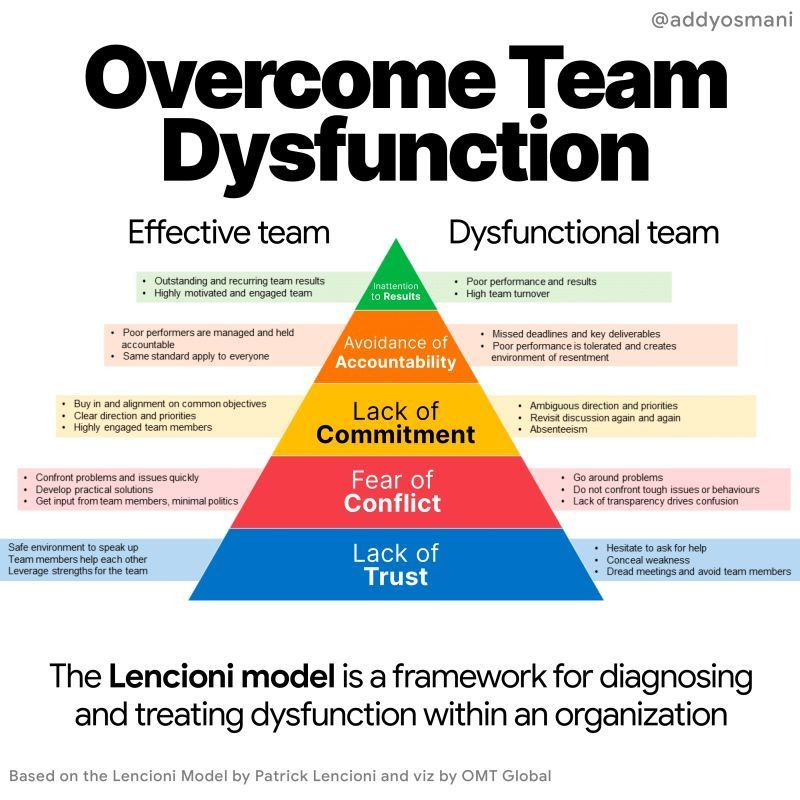
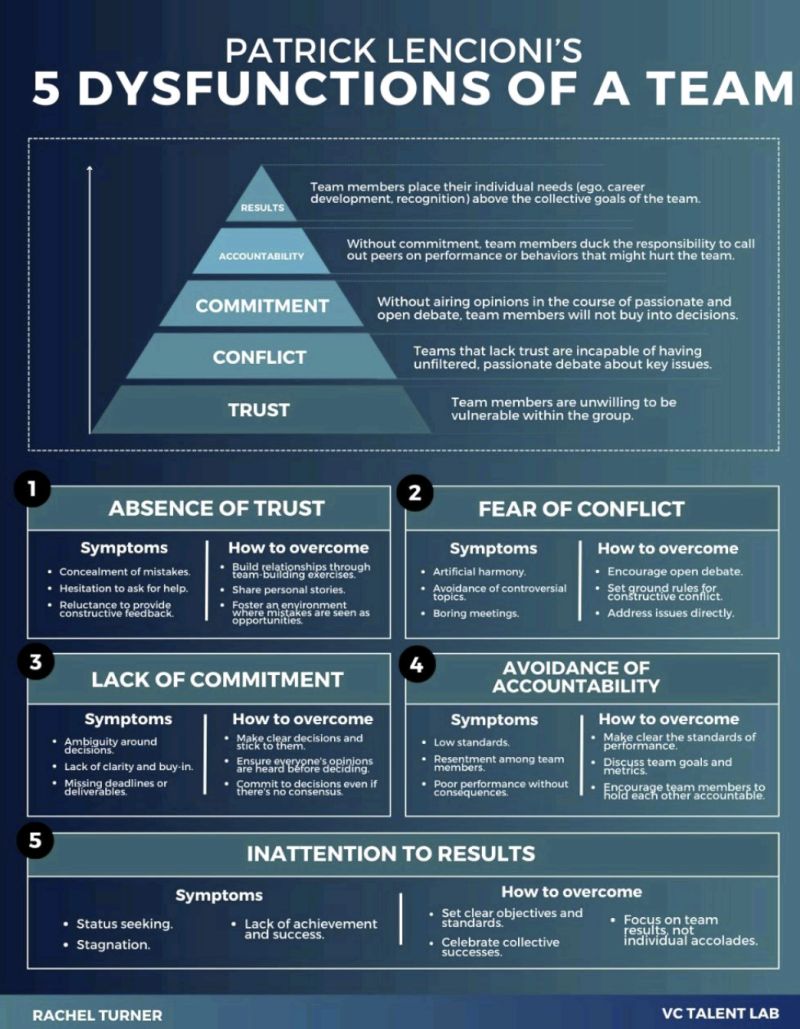
In The Five Dysfunctions of a Team: A Leadership Fable, Patrick Lencioni explores why even the best teams struggle.

The five dysfunctions are:
- absence of trust
- fear of conflict
- lack of commitment
- avoidance of accountability
- inattention to results.
They are visually represented in the form of a pyramid to underline that you cannot resolve the issues of a higher level without addressing the lower level needs first.
A helpful article summarizes the book can be found HERE.
For a survey you can use with your team click HERE.
How to handle a lack of trust

Build a foundation
- Show vulnerability
- Give it time
- Discuss failure to build from it
- Be honest
- Honour commitments
- Be transparent
- Use humour
- Look at it from a different perspective
- Be appreciate and consistent
How to build commitment

Identify the root cause
- Build trust
- Develop a shared vision together and define roles and responsibilities
- Ensure all team members feel valued
- Model commitment
- Foster a growth mindset
- Support and invest in staff
- Knowing your team
- Encourage creativity and collaboration
- Allow freedom and autonomy
- Eliminate the fear of failure
- Promote group identity
- Offer sincere and consistent praise and celebrate success
How to hold people accountable
In the article 8 ways to improve accountability in your team the following is suggested:
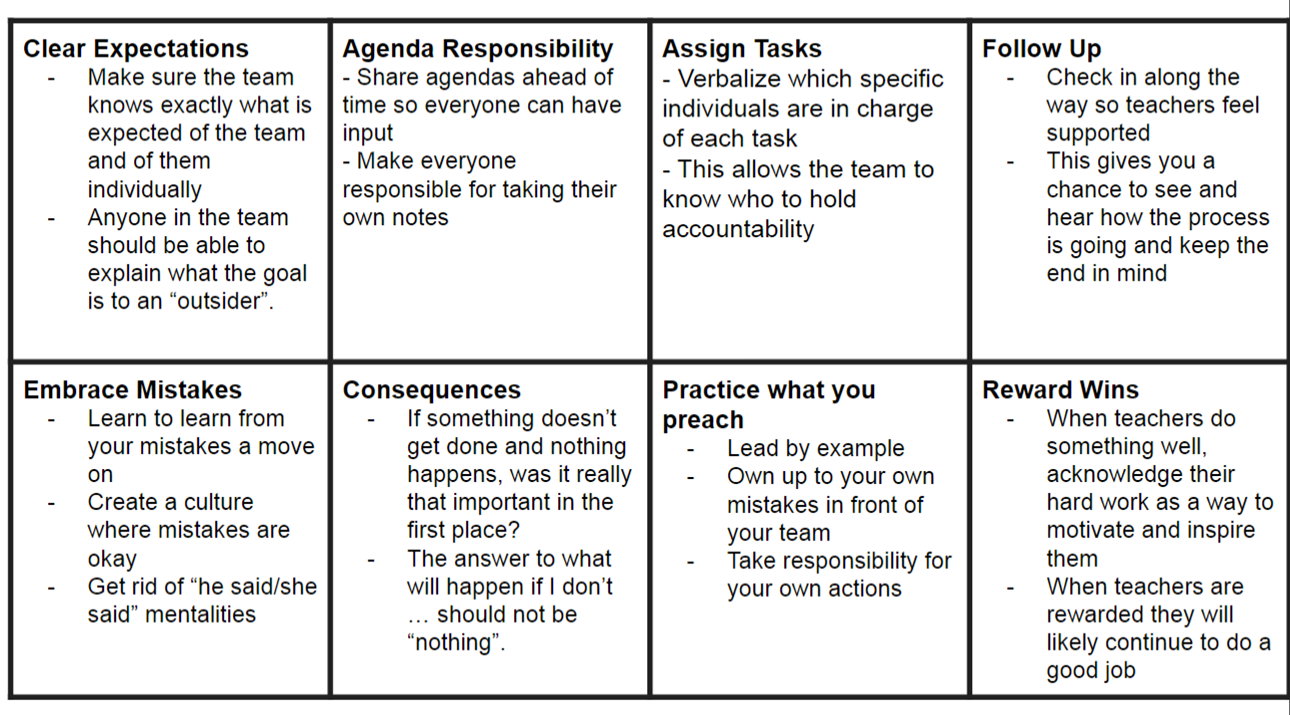
Set clear expectations, and document them.
- Make everyone responsible for team meeting agendas.
- Assign tasks to individuals.
- Follow-up.
- Adopt an “embrace mistakes” mantra...
- but make sure there are consequences.
- Reward wins.
- Practice what you preach.
Who’s Accountable?
In every school, department, or team, there are moments when something important doesn't get done—and no one can quite say why. Maybe a deadline is missed, a parent is left uninformed, or a key initiative fizzles out. What’s more frustrating is when everyone thought someone else was handling it.
To illustrate the point, here’s a classic little story that perfectly captures what happens when accountability is absent:.
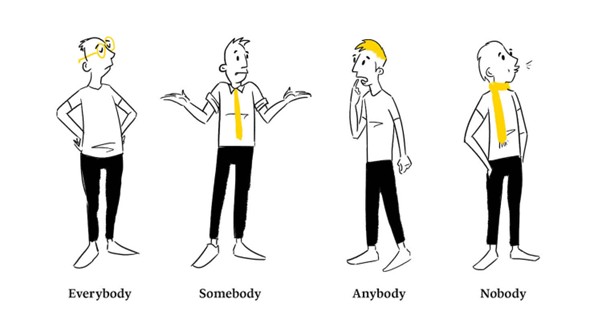
This is a story about four people named Everybody, Somebody, Anybody and Nobody.
There was an important job to be done and Everybody was sure that Somebody would do it.
Anybody could have done it, but Nobody did it.
Somebody got angry about that, because it was Everybody’s job.
Everybody thought Anybody could do it, but Nobody realized that Everybody wouldn’t do it.
It ended up that Everybody blamed Somebody when Nobody did what Anybody could have.
The story may be confusing, but the message is clear:
When no one takes responsibility, nothing gets done. It sometimes plays out in schools on a daily basis, whether it’s an unaddressed behaviour issue, missed communication with families, or tasks that slip through the cracks, the root cause is often the same: no clear ownership.
Top Tips
If you’re a team leader in a school setting—whether leading a department, a year group, or a pastoral team—here are some focused strategies to avoid falling into the “Everybody-Nobody” trap:

Be the example: If you expect your team to take responsibility, model it first. Show consistency, ownership, and transparency in your own actions.
Be clear about roles: Never assume others know what's expected. Clarify tasks, ownership, and deadlines—in writing where possible.
Set the standard: Define what success looks like. Clear goals and time frames give people something to aim for—and make it easier to hold them accountable.
Get team buy-in: People are more likely to follow through if they feel part of the vision. Make sure each person understands why their role matters.
Check in regularly: Don’t let weeks go by without follow-up. Scheduled check-ins help maintain focus and prevent drift.
Support and train: Especially in schools, staff are often asked to take on unfamiliar roles. Make sure they have the tools, training and time to succeed.
Encourage open conversation: Create a safe culture where people can talk honestly about what's not working—without blame.
Focus on solutions: When things go wrong, don’t just dwell on the problem. Ask: “What do we do next?”
Acknowledge effort: Catch people doing the right thing. Praise specifically and publicly, and coach privately when improvement is needed.
Final Thought
Avoid becoming the leader of a team where Everyone thinks Someone else will do it. Take the lead, set the tone, and create a culture where accountability is the norm—not the exception.
Lead from within, and don’t let Anybody (or Everybody, Somebody or Nobody) stop you from building a team you can be proud of.
Reflection: What is your teams' 4-minute barrier?
The video “Mindset Is Everything – Teamwork Motivational Video” by Tyler Waye emphasizes how the right mindset underpins effective teamwork. It argues that collaboration, improvisation, resilience, and belief are what allow teams to overcome challenges.
Key messages include:
- That success in teams depends not just on skills or roles but on the mindset individuals bring
- That adaptability and mutual support help teams prevail through uncertainty
- That each team member has a unique contribution which, when aligned, strengthens the group as a whole
One of the central differences between an average team and a high-performance work team is the capability to handle conflict in a constructive way. Any conflicts that surface must be depersonalized and dealt with early, either between individuals or among the collective team. Instead of viewing conflict as a negative, a high-performance team views it as a strength of the collective group. Diverse views help improve thinking, learning and overall performance.
Identify potential conflict situations involving a member of staff, a student or a parent.
Collaboratively share how you have previously handled such situations - which strategies have you used? How do you approach the situation?
Watch the video of the Thomas-Kilman conflict model
Reflect: which key words, phrases resonate - why?
Resource:
How to resolve workplace conflicts,The Society for Human Resources Management (SHRM).